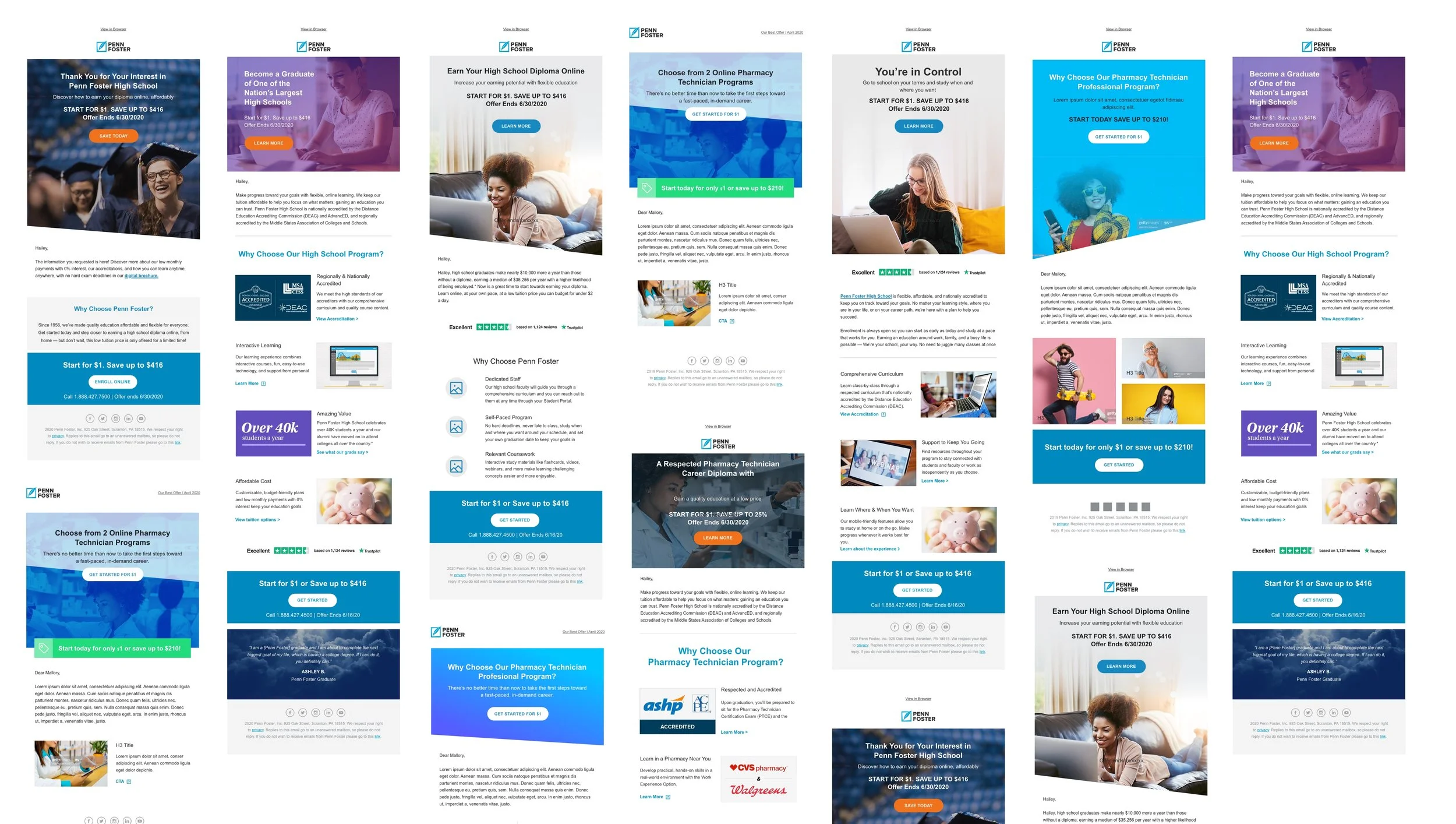
Building an Email Design System to Scale Marketing Across Eight Brands
Sector: Education, E-learning, Higher Education
Challenge: The organization had acquired eight new schools, each with unique branding, technology requirements, and various levels of email campaign maturity. The existing email templates were static and not optimized for mobile or accessibility. Consistency was difficult to maintain between campaigns and turnaround times were slow, averaging 10 business days per template.
My Role: Art Direction, Strategy, Workshop Facilitation, UX Design, UI Design
Collaborators: Michael Brennan (UI Design), Talia Cuccia (Email Development)
Timeline: 3 months (2018)
Platform: Adobe XD, Acoustic Email Platform, Google Docs
Deliverables: Themeable component library, style guides for 8 brands, documentation, lead nurture email series
Executive Summary
I led the creation of Penn Foster's first email design system to support rapid campaign development across eight newly acquired brands. By facilitating cross-functional workshops with the Lifecycle Marketing team, I identified the need for flexible, component-based templates rather than rigid, static layouts. The resulting system featured themeable components that could adapt to each brand's identity while maintaining consistent UX patterns. This work introduced systematic design thinking to the marketing organization and reduced email production time from 10 business days to same-day turnaround for standard campaigns.
Workshop-Driven Requirements Gathering
Intake Workshop
I facilitated a one-hour workshop with the Lifecycle Marketing team to identify challenges, technical requirements, business goals, deliverables, and timelines. This collaborative session ensured we understood the full scope of needs across all eight brands.
Challenges: Inconsistent design, static template layouts, not responsive, often broken, time-consuming to update and build (10 business day turnaround)
Requirements: Responsive, flexible layouts (component-based, not template-based), themeable (ability to swap out brand colors, logos, and fonts for each brand), modern design
Technical Requirements: To be built in Acoustic email platform
Business Goals: Increase lead conversion, optimize lead nurture series for Penn Foster, and build new campaigns for acquired schools
Solution: A design system of interchangeable components they could mix and match to create unique email templates on demand
Deliverables: Component library built in Adobe XD with specific components to be identified in a future workshop

Using Miro to audit the existing email templates and brainstorm.
Content Audit & Design Inspiration
The Lifecycle marketing team provided links and screenshots to their most commonly used email templates. We gathered design inspiration from leading email examples on reallygoodemails.com to understand current best practices and innovative approaches.
Workshop Outcomes:
Templates Needed: Lead nurture multi-touch series, offer emails, payment confirmations, refer a friend, event announcements
Component Needs: Header, footer, hero, offer, and savings modules, Trustpilot review integration, body copy blocks, contact and support information, multi-column content layouts
Design Inspiration: AirBnB, Framer, Google Nest, Lending Tree, Vacasa, Canva

Gathering inspiration from reallygoodemails.com
designComponent Library and Multi-Brand System
Using existing brand guidelines, I created simple style guides for each of the eight brands, including typography scales, color palettes, logo specifications, and button styles. This ensured visual consistency while allowing for brand flexibility.
I sketched component layouts to inform wireframes, then built them in Adobe XD using my established style guides. The component-based approach allowed the marketing team to assemble emails quickly by combining pre-built, tested modules.
Email style guides for Ashworth College, James Madison High School, NYIAD & NYICD.

Sample of email components.
Lead nurture series built using email design system components and the brand style guide.
Documentation and Team Enablement
I established a naming convention for components and created documentation in Google Docs outlining component usage, guidelines, and copy character limits. This accessible format made it easy for the marketing team to reference requirements and enabled them to work independently without constant design support.

Documenting component names, usage guidelines and character limits for copy.
Impact: Introducing Systems Thinking to Marketing
This project was my first attempt at building a design system. The constraints of email design (limited CSS support, responsive considerations, and cross-client compatibility) actually helped me keep the styles simple yet flexible. The system scaled successfully across Penn Foster's eight brands, enabling the marketing team to create consistent, on-brand emails for all properties.
Business Impact:
Reduced email production time from 10 business days to same-day turnaround for standard campaigns
Enabled rapid scaling across eight brands following the acquisition
Created consistent user experiences across all email touchpoints
Increased team velocity and reduced dependency on design resources for routine campaigns
Process Innovation:
Introduced workshop-based discovery to uncover real user needs rather than assumed requirements
Established component-based thinking in an organization accustomed to one-off template creation
Created accessible documentation that empowered non-designers to use the system effectively
Team Transformation:
Working with easily accessible tools like Google Docs made it simple for me to collaborate with the marketing team and introduce the concept of systematic design to the organization. The success of this project built credibility for design systems work and paved the way for larger initiatives.
Key Learnings:
While I appreciated the collaborative benefits of Google Docs, if I were to approach this differently today, I would use a more robust documentation platform like Zeroheight (which I later used for Hinge, The Penn Foster Design System). A dedicated documentation tool would provide better visual presentation, version control, and integration with design files.
The biggest lesson was understanding that design systems don't have to be complex to be effective. Starting with email's constraints helped me focus on core principles of modularity, consistency, and reusability that I've applied to every design system since.